Westflo Pigment Orange – 13

WESTFLO PIGMENT ORANGE – 13

Safety Data Sheet According to Regulation EC No. 1907/2006 (REACH), EC No. 1272/2008 (CLP)Revised : 06-May-2024
1. IDENTIFICATION OF THE SUBSTANCE/PREPARATION AND OF THE COMPANY/UNDERTAKING
Trade nameWestflo Pigment Orange - 13
Product type Bis Azo pigment
CAS Number3520 – 72 – 7
CI Number 21110
EINECS number222-530-3
Primary Product UseColorant
CompanyWESTERN CHEMICAL INDUSTRIES ( P ) LIMITED
Telephone( 91-22 ) -2387-4646 • 2387-4647
Fax( 91-22 ) -2387-4648 • 2387-4649
Email
2. COMPOSITION/INFORMATION ON INGREDIENTS
Material or ComponentCAS No%Hazard Data
Pigment Orange – 13 3520 – 72 – 7 100Not available
3. HAZARDS IDENTIFICATION

Expected Route of Entry: Skin Contact, Eye Contact, Inhalation
Effect of Acute Exposure:
Eye: May cause mild eye irritation
Skin: Prolonged or repeated contact may cause mild skin irritation.
Inhalation: May cause nausea.
HMIS
Health: 1 Flammability: 1 Reactivity: 0 Personal Protection

4. FIRST AID MEASURES
  • Eye Contact: In the case pigment comes into contact with eyes, it may cause irritation. In this flush eyes thoroughly with water for at least 15 minutes. If irritations persist, consult your physician.
  • Skin Contact: In the case pigment comes into contact with skin, it may cause irritation. In this case wash skin with soap and water. Remove severely contaminated clothing and clean before reuse. Seek medical attention if irritation persist.
  • Inhalation: In the case pigment is inhaled, it may cause respiratory irritation. In this case remove to fresh air. Get medical attention if necessary.
  • Ingestion: In the case pigment is ingested it is not considered to be toxic. If swallowed, dilute with water and induce vomiting. Never give fluids or induce vomiting to an unconscious or person having convulsions. Contact medical help immediately in this case.
5. FIRE FIGHTING MEASURES
  • Flammability Classification: Not Hazardous
  • Flash Point: Not Applicable
  • Flammable Limit in Air: Not Established
  • Auto ignition Temperature: Not Established
  • Extinguishing Media: Water, Foam, CO2, Dry Chemical
  • Special Fire Fighting Procedures: Exercise caution when fighting any chemical fire. Use NIOSH-approved self-contained breathing apparatus and full protective clothing.
  • Unusual Fire & Explosion Hazards: May form explosive dust-air mixtures in the finely divided state.
6. ACCIDENTAL RELEASE MEASURES

No specific hazards are encountered under normal product use.
Step to be taken in case of spill:
Small spills may be flushed to the sewer. Large spills could be collected by shovelling into appropriate waste collection containers. Clean-up by flushing with water if desired.

7. HANDLING AND STORAGE

No specific hazards are encountered under normal product storage.

  • Handling: Avoid dust formation. Keep away from ignition sources. Avoid breathing dust and contact with skin, eyes and clothing. Wash with water thoroughly after handling.
  • Storage: Store in a cool, dry, well-ventilated area. Keep container sealed when not in use.
8. EXPOSURE CONTROL / PERSONAL PROTECTION
  • Respiration Protection: A NIOSH approved respirator as necessary.
  • Protective Equipment: Safety glasses (with side shields), Synthetic gloves.
  • Ventilation: Local exhaust ventilation recommended.
  • Exposure Guidelines: OSHA PEL/TWA: Not established; treat as nuisance dust:
  • 15 mg/m3 (total dust); 5mg/m3 (respirable fraction)
9. PHYSICAL TYPICAL AND CHEMICAL PROPERTIES
  • Form : Powder
  • Color : Reddish Orange
  • OdouR :  None
  • Ph  : 6.5 – 8.0
  • Solubility in Water: Insoluble
  • Density : 1.31-1.60 g/cm3
  • Oil Absorption: 40 +/- 10

Change in physical state

  • Melting point : N.A.
  • Flash point :  N.A.
  • Fire supporting
  • properties : Thermal decomposition can cause liberation of obnoxious And toxic fumes
  • Steam pressure :  N.A.
10. PHYSICAL AND CHEMICAL PROPRTIES
  • Stability: Stable
  • Incompatibility: Avoid strong oxidizing agents such as peroxides, chlorates, perchlorates, nitrates, and permanganates. Oxidizing materials may vigorously evolve oxygen, in large amounts. This product is a stable compound and hazardous polymerization will not occur.
    Hazardous Decomposition
  • Products: In case of fire pigment may evolve toxic fumes
11. TOXICOLOGIOCAL INFORMATION
  • Acute oral toxicity: LD 50 (rat): >5000 mg/kg
  • Acute inhalation toxicity: Not Available
  • Acute dermal toxicity: Not Available
  • Skin irritation: Not Available
  • Eye Irritation: Not Available
12. ECOLOGICAL INFORMATION

Organic pigments, in general, are not expected to be toxic to fish because of their negligible water solubility thus they are not readily biodegradable.
Specific eco-toxicological data is not available for this product

13. DISPOSAL CONSIDERATIONS

RCRA Status: This product is not regulated as a toxic hazardous waste under 40CFR261
Waste Disposal Method: Disposal of this material must be made in accordance with Federal, State and Local regulations.

14. TRANSPORTATION AND SHIPPING REQUIREMENTS

D.O.T Shipping Name (49 CFR 172.101-102): None
D.O.T Hazard Class (49 CFR 172.101-102): None
D.O.T Label: None AArbor Orange 1300N Page 4 Version: 1 Date: January 2012

15. REGULATORY INFORMATION

OSHA Hazard Communication Standard Status: This product is not considered to be a hazardous substance under OSHA’s Federal Hazard Communication Standard 29 CFR 1910.1200.
Toxic Substance Control Act (TSCA) Status: All of the ingredients of this material have been reported to the U.S. EPA and are included in the TSCA chemical inventory.
Sara Title III
Section 302 (EHS): None
Section 311/312 (Acute): None
Section 313: None
RCRA: Not Regulated as a hazardous waste under RCRA.
CEPA (Canada): All ingredients of this material have been listed on the Domestic Substance List (DSL).
EINECS (European Economic Community): All components of this product are on the EINECS list.
California’s Proposition 65 Regulated Substances: None
Massachusetts Substance List: None
CONEG: This product is certified to be in full compliance with CONEG legislation for packaging and packaging ink components regarding hexavalent chromium, cadmium, lead, and mercury.
Ozone Depleting Substances (ODS): This product neither contains nor is manufactured with an ozone depleting substance subject to the
Labeling requirements of the Class Air Act Amendments 1990 and 40 CFR Part 82.

A. SPECIFICATON:
Product type Pigment Orange - 13
Trade Name Westflo Orange - 13
Appearance Yellowish Orange Powder
Chemical characterization Disazopyrazolone
C.I. No 21110
CAS Number 3520-72-7
EC Number 222 – 530 – 3
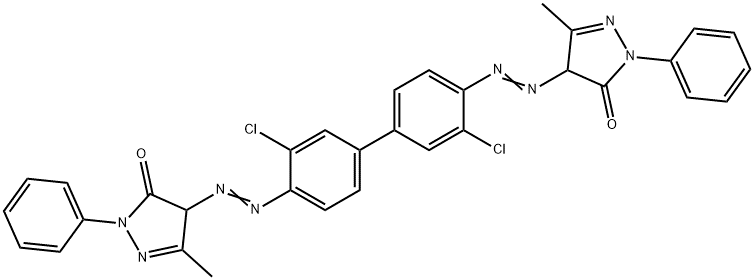
Molecular FormulaC32H24Cl2N8O2
Molecular Weight623.49
Hue Yellowish Orange
B. CHEMICAL NAME:
4,4′-[(3,3′-dichloro[1,1′-biphenyl]-4,4′-diyl)bis(azo)]bis[2,4-dihydro- 5-methyl-2-phenyl-3H-pyrazol-3-one]
C. STRUCTURE OF PIGMENT ORANGE 34
D. APPLICATIONS

Properties and  Recommended Uses : P.O.13, also known as pyrazolone orange, comes in semitransparent types with specific surface areas between about 35 and 50 m2/g. It is coloristically very similar to P.O.34, but generally somewhat yellower

* Inks : PO – 13 gives Yellowish Orange Hue. Its Ink printing application includes Offset and Flexo printing inks. Also applicable for Solvent & Water Gravure.

In Polyamide & NC / Vinyl applications. it provides fairly good solvent fastness. However its Light fastness is moderate. Used due to its competitive price. 

* Polymers : PVC: Considering its tendency to migrate, incorporation into plasticized PVC is not recommended. The pigment blooms over a large concentration range and bleeds

considerably. Even at low concentrations ca. PO-13 is not suited for use in rigid PVC.

* Polyolefins : Application of P.O.13 in polyolefins is limited –  It is recommended for use at temperatures up to 200°C only.  Even Polystyrene and other Plastic materials are to be processed below 200°C.  In LDPE, there is some danger of blooming.

* Rubber : PO.13 can be used in the rubber industry. It is fast to vulcanization and bleeding in natural rubber.

* Paints : P.O.13 shows less stability in paints compared to P.O.34 of similar particle size.

This includes both fastness to over painting in baking enamels and light fastness in air drying paints. The volume of trade sales for this purpose is accordingly limited

* Others  ; The graphics industry uses P.O.13 to an appreciable extent for packaging printing inks though its fastness to light is average.

As the stability of pigmented prints of PO-13 towards to a number of organic solvents is excellent used in packaging of paraffin based products, butter, and soap. They withstand heat very well and are stable up to 200°C ard also used for metal deco printing, provided its light fastness suits the purpose.

E. PROPERTIES
Physical Data Moisture % 1.0
Specific Gravity.............. 1.5
Bulk Density (Kg/Lit))....... 0.4 – 0.5
Oil Absorption (g./100g.) 35 to 50
Specific Surface area 27m2 /g
Stability Heat ......................... 4
Heat Stability 170 oC
Alkali ...................... 3 – 4
Acid............................ 3 – 4
Light fastness*" (Full) ..... 6
(Tint) ..... 5 – 6
Bleed Resistance Data Water,......................... 5
Alcohol 4
MEK. ......,....,.,.........,.. 4
Mineral Turpentine 3 - 4
Xylol .......................... 3
Linseed Oil ...................... 3 – 4
Soap Water .............. . ...... 4 - 5
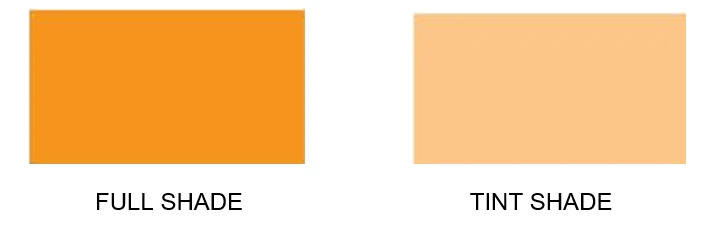
F. TYPICAL COLOR PRINT OF WEST FLO PIGMENT ORANGE - 13